
No-Bid Contracts Just Hit a 10-Year High. Here's What the Data Actually Shows
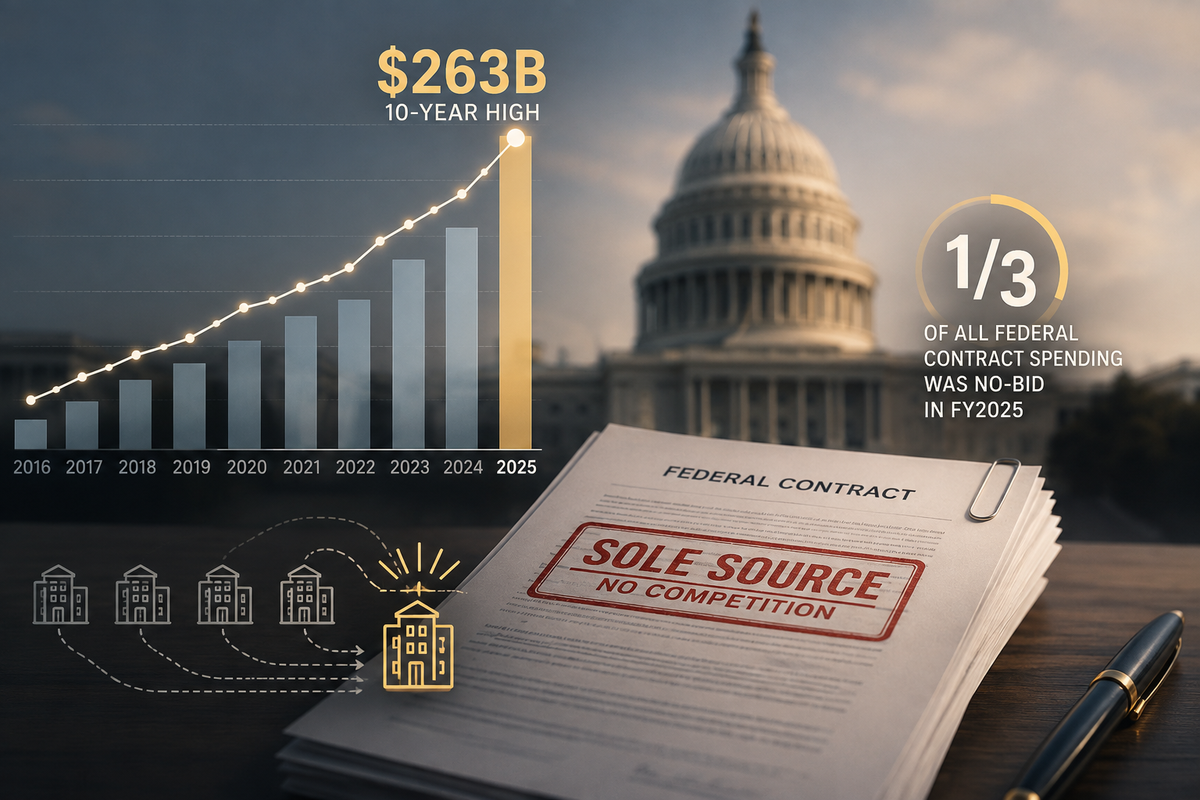
In fiscal year 2025, the US federal government spent close to $263 billion on contracts awarded without competitive bidding, according to an analysis by the Project on Government Oversight (POGO). That's the highest total in at least a decade, and it's not a small share either: sole-source awards made up roughly a third of all federal contract spending that year. POGO projects fiscal year 2026 could land near $300 billion.
These contracts have a formal name most people don't use. "No-bid" is the everyday term. In federal procurement law, it's called a sole-source contract: an award made to one vendor without running the usual competitive process.
What "no-bid" actually means, in practice
Under the Federal Acquisition Regulation (FAR), agencies are generally required to seek full and open competition. There are recognized exceptions, and they're not automatically a red flag. A contract can legitimately skip competition when:
- Only one supplier can realistically do the work (a proprietary system, a patented technology)
- There's a genuine emergency and there's no time to run a normal bid process
- The work is classified or tied to national security in a way that limits who can even be approached
- An existing contract is being extended briefly to avoid a service gap while a new competition is arranged
Contracting officers are supposed to document which of these justifications applies, using a reason code. A large share of the FY2025 no-bid spending was filed under what's informally called "Code C," which covers contracts where the agency argues that competition wasn't practical, citing urgency, national security, or public interest. According to public spending data, the Department of Defense accounted for the large majority of no-bid dollars in FY2025.
Why this number is worth watching, not just reporting
A rising no-bid total doesn't automatically mean something improper happened in every case. Genuine emergencies come up. Some technology really does have only one working supplier. But the reason procurement watchdogs pay close attention to this metric is what competition is actually designed to do: it creates price pressure. When a vendor knows it's the only bidder, there's no market pressure keeping the price honest, and no outside proposal to compare it against.
That's also the core difference between a no-bid contract and a normal open tender. In a competitive process, a buyer publishes requirements, sets a submission deadline, and lets multiple vendors respond before making a decision. That process takes real time. Data from procurement platforms that track thousands of live tenders shows the average gap between a tender's publication date and its submission deadline typically runs into weeks, sometimes months, depending on the sector and contract size. A sole-source award skips that window entirely. There's no publication date for competitors to react to, because there's no competition to react to.
A quick way to check the numbers yourself
You don't need to take any single analysis at face value. The underlying contract data is public:
- Go to USAspending.gov, the federal government's official spending database
- Filter by "extent competed" or "type of set aside" to isolate sole-source awards
- Break it down by agency and fiscal year to see which parts of government rely on it most
The competition requirements themselves, along with the recognized exceptions, are laid out in FAR Part 6, the government's own regulation on full and open competition. Reading the exceptions directly is a useful exercise. Some of them are narrower than the "national security" and "urgency" headlines suggest, which is exactly why the reason codes attached to each contract matter as much as the dollar totals.
The number to watch next
FY2026 isn't over yet, and POGO's $300 billion projection is an estimate based on the spending pace so far, not a final figure. Whether that number actually lands there, or whether the second half of the fiscal year brings a shift back toward competitive procurement, will show up in the same public data anyone can pull today. Worth checking back on in a few months.
